Showing posts with label Tutorials. Show all posts

Wednesday, July 9, 2014

Baby Wipes Tutoriolito - A great way to use up random flannel scraps

I like to back quilts in flannel occasionally. It is so soft and makes the quilt extra snugly. But what does one do with all the odd shaped remnants left over? No brainer if it was backed with quilting cotton I would just throw the scraps into my scrap box and use for piecing later. But I don't like to mix my flannel or other fabric scraps up with my quilting cottons because I rarely (if ever) piece with a mixture of fabric types. And throwing them out is not an option because the flannel is still good! So I ended up with a pile of weird long rectanglish flannel scraps that I never used.

My friend Cassie keyed me in on a great way to use up the flannel scraps - make reusable flannel baby wipes. These are a great option for when baby goes #1 because they are super absorbent so you only need one and they won't be sopping wet, so less diaper rash. Plus you can just throw them in the wash and reuse over and over.  If you already cloth diaper or are considering it, these are a perfect accompaniment.


There are tutorials already out there such as this one by Sew Much 2 Luv. But I thought I would just give you the TLDNR version.

1)  Take two scraps of flannel and cut them into an 8" square or 9" or 10" or make it slightly rectangular. It doesn't much matter as long as the two pieces are the same size. Really I let the size of my scraps dictate the size of the wipe so that I was as economical as possible with the fabric. 
2)  Sew them together right sides facing with a 1/4" seam leaving a 2-3" gap in the center of one of the sides. 
3)  Snip off the excess fabric at each corner to remove some of the bulk
4) Turn them right side out and press taking care to press the opening down nicely
5) Topstitch around the square 1/8" from the edge making sure to stitch the opening closed. 

 The top row were made with 8" squares and the bottom were made from 10", 10" and 9" squares.

So go ahead and dig through your flannel leftovers and make a few for yourself or for a friend who is expecting. They take 5 minutes each (or less) and you can wrap them up with a pretty bow and be the star of the baby shower (not that these things are competitions, yeah right).

Saturday, November 9, 2013

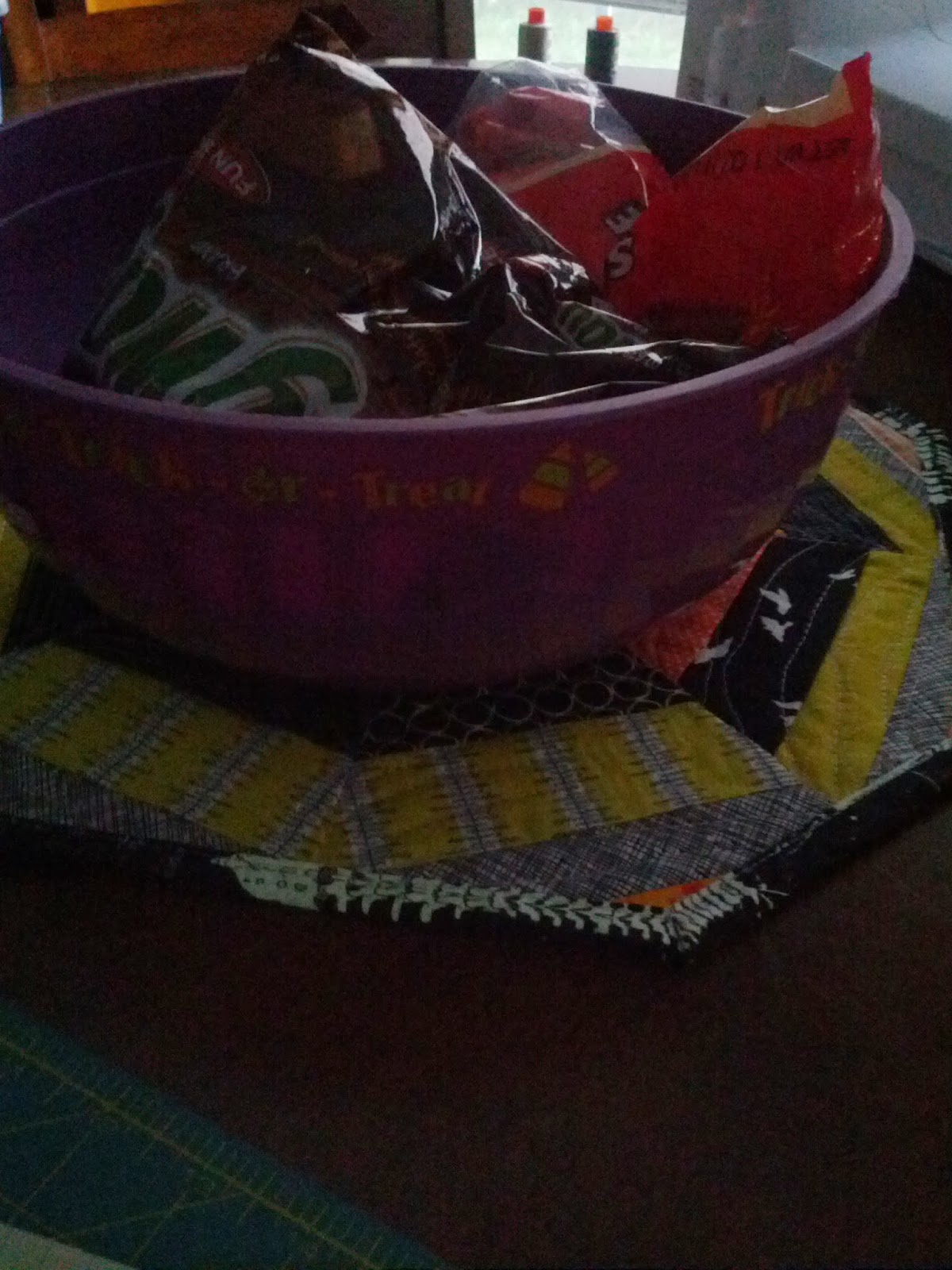
Halloween Mini Quilt/Placemat {A Tutorial}

Want to make a super cute octagonal mat for Halloween Thanksgiving or Christmas? This tutorial will show you how to make a place mat to go under a bowl, perfect for decorating the table for any holiday or just because. I made a Halloween version to distract me from eating all the candy. It worked pretty well! Of course I meant to blog about it before Halloween but you know how it goes.


Just a disclaimer, I used some fun quilt maths to design this block but it turned out NOT to be a regular octagon. For those of you who have forgotten your geometry, a regular octagon is has 8 sides of equal lenght. The disclaimer is that I wouldn't recommend trying to make something out of multiples of this block. Instead use Elizabeth Hartman's tutorial for the octagonal orb quilt block. She must have gotten an A+ in geometry.

Octagonal Mini:
All seams are 1/4". Please read through all the directions before you start. This is a foundation paper piecing pattern and the skill level is somewhere around confident beginner/intermediate sewists.

Start with 4 pieces of 8" x 11" paper and cut it into an 8" square. Then cut along the diagonal like so,

 I cut through all of the pieces at once to save time. Just be mindful to line everything up and keep it lined up after you cut!

Then mark 4" in from the top left corner and cut across that line diagonally. 

You should end up with 8 pieces than can be rearranged like this. Tada you're done!
 This is a good time to label each piece A - H on the front and back of each piece with a pencil. Oh and make sure you label which side is the front. Trust me, you'll thank yourself later when they all start looking the same.


Now you will use the foundation piecing stitch and flip technique. There are lots of great tutorials about this method like Rachel's Ziggy Strings from Stitched in Color.

Take your first piece of paper right side up and lay a strip of fabric along the widest part also right side up. You can use a glue stick to keep it stuck to the paper if you so choose. Layer another strip on top right side down and sew a 1/4" seam. Use a smaller stitch length, I set my machine to 1.4, so that the paper will rip off easily later.

Here is what the back will look like:


Then press down the seam and follow the same procedure all the way down the paper until it looks like this:


Trim your block using the paper as a guide. Do the same for the other 7 pieces of paper.

Now rearrange the blocks and sew A to B, C to D etc. Then sew AB to CD and EF to GH. And finally sew ABCD to EFGH.

Then make a quilt sammich and quilt as desired. I chose to free motion quilt a spider web design. I really wish I had some glow in the dark or silver metallic thread at this point but instead I went with some good ole 40wt light gray Aurifil.

The quilting shows up nicely on the back:

Bind it. At this point I am too lazy to write a tutorial for how to bind weird angles but luckily Jaybirds quilts has one so knock yourself out. And voila there you go:

I cut all my strips different sizes and went for a wonky look, but you could use the same sized strips and make a less scrappy looking version. I am so happy with mine. In my opinion, the addition of the electric yellow really elevates the color scheme from traditional to Shriek Chic ©.

And look, I didn't even open the candy!!

Here is a shot in the "dark." I used a glow in the dark skeleton fabric for the binding and I was trying to get a good image of that but my camera phone is not exactly the right tool for that job. Either way, you'll have to trust me that it looked super cool on Halloween night!


If you make one of these mats for Thanksgiving, Christmas, Hanukkah, Festivus or for everyday use. I would love to see a picture of it! 

Saturday, October 19, 2013

Mount Tsuru - Bonus Pillow!

Remember my Mount Tsuru quilt from the last post? I used Janice's (Better Off Thread) Moda bake shop tutorial called Sunnyside diamond zig-zag. The tutorial is easy to follow. But, hypothetically, if you do not follow the directions correctly (maybe because you did not read ALL of the directions before you started cutting) you get to turn the mistake into a beautiful bonus pillow:

I turned my oops block into this pillow and used some Essex linen in flax for the back. 


Want to learn how I quilted this baby??

I actually used straight line quilting with my walking foot. I quilted the front and back with this same design. Quilting how to:

1. I cut out a petal shape from a piece of paper and traced it onto the pillow top four times (black lines below). Then I stitched over the line following the arrows.
2. Then I quilted inside each of the petals (pink lines below) echoing the first quilting line until I filled the petal.
3. Last I echo quilted outside the black lines until I filled up the rest of the pillow top (blue lines).

I'll address any questions you have about the quilting how to in the comments and please let me know if you try it out!

Monday, July 22, 2013

No fuss circle applique {A tutoriolito}

Here is any easy way to applique circles without those pesky raw edges. I'm not snubbing the raw edge, but sometimes you just want it neat. It is perfect for circles of all sizes.

Supplies!
A circle of fabric*** 
A square of lightweight fusible interfacing the same size as the circle (single sided is fine)


1. I traced a cookie cutter onto fabric and cut out a circle. Then I cut out a square of interfacing just larger. You could cut out a circle of interfacing the same size as your fabric but that is just more work, no thanks!
***Ooh alternatively you don't need to cut a circle out either - just draw a circle on the wrong side of the fabric and sew along that line in step 3. I bet that would give you an even MORE perfect circle.

2. Align the fabric onto the interfacing right sides together. Ergo, right side of fabric with fusing side of interfacing.

3. Sew ALL the way around with a 1/4" seam - or you best attempt at one.

4. Cut away the interfacing and snip around the curves being careful not to snip through the seam. See this is why you don't need to cut a circle of the interfacing. 

5. Cut a line into the interfacing being careful not to cut the fabric. Turn your circle right side out and wrangle it into submission with your fingers, a pokey tool but do NOT iron:

SERIOUSLY DO NOT IRON. Remember the fusible interfacing is still on the back.

6. Arrange your circles in a pleasing way. The gods will let you know when you have achieved circle placement enlightenment.

7. Now you may iron. Press them onto the new fabrics according to the directions for your particular interfacing.

8. Sew 'em down using your preferred method. I chose a blanket stitch. The fabrics I used were some scraps from Kona Modern Quilts line by Robert Kaufman.

This tute is brought to you by the rain because this is what most of my weekend looked like:

I hope you have a happy week. As always if you try my tutorial I would love to hear about it. Hashtag it with #sewinghungry

Tuesday, May 14, 2013

String-A-Hex Block Tutorial

Rachel over at Stitched in Color is having a String Fever sew-a-long and she just announced some killer prizes. But don't enter and dilute my chances of winning. Seriously.

I love, love, love using up scraps. It makes me feel like I am saving the environment which brings me an endless smug satisfaction. I wanted to try a strip paper piecing using equilateral triangles and thus the string-a-hex block is born. 


Each triangle has a unifying strip of white fabric that when pieced will make a hexagon. You can vary the position and width of the white fabric to get different sized hexagons or you can choose a uniform design.

1) First make some 8.5" equilateral triangles. Take a piece of printer paper* and line up the 60 degree line of your ruler with the bottom of the paper. Cut along the long edge of the ruler.
* I used an old journal article. Scientist's houses are full of em

2) Rotate the ruler and do the same to the other side. In the end you should have a triangle that is 8.5" on each side. The width of standard printer paper is 8.5" so this is the largest triangle you can make from this particular type of paper. But feel free to make any size triangle you want.


3) Piecing the blocks is almost as straightforward as strip piecing a square. Stack 6 triangles and fold the top point down. Make sure your crease is parallel with the base. This is easy to do when you used lined paper. Then place the white strip along the crease (either side, just be consistent).


4) Place the next strip right side down and line it up with the white. When you are working from towards the center point make sure the next strip overlaps completely with the previous one so that it will cover up the paper once it is sewn. Press the seam.


5) When piecing from the inside to the outside of the triangle you have to pay a bit more attention to the fabrics you chose for the next strip. Let's entertain some options:
This red piece is too short!! If you sew it on there will be lots of visible paper.

This piece is more than long enough. Go for it!

If you forget to center your next strip right and it doesn't fit across the block - DONT PANIC.  


Fold back the paper along the stitch line and cut off the part of the strip that doesn't fit.


6) Keep adding strips until you cover the entire paper. Remember that the last 1/4" will be lost in the seam allowance when you sew the blocks together so you may want to use a fairly wide strip for the last piece.


7) Trim that triangle! Simply cut along each edge of the paper to trim it down to size.

Make lots and lots more. Try a solids only, or keep it monochromatic. The sky's the limit with these.
 Here are some of mine. Once you finish all your blocks decide on a layout and then piece each of the rows. Here is a good reference on how to piece equilateral triangles from Freshly Pieced Bloom Bloom Pow-a-long.

I hope you like this tutorial. If something is unclear please ask and I will address it in the comments. If you use this tutorial I would love to see pictures! Now I need to get my ass in gear to finish up mine before the Strip Fever deadline.

Thursday, May 9, 2013

Le Pouch Tutoriolito

This tutoriolito will teach you how to make two panels for one Noodlehead medium sized open wide pouch. It is not a full fledged tutorial because I cannot take credit for the bag construction. That's all Anna. Also, I didn't really ask her permission for this tutoriolito but I think she will forgive me :) 

The medium sized pouch is a versatile size, but, if you wanted to make a smaller or larger pouch do your own math, geeze!

This is a great use for small scraps. You will basically be constructing a 4 x 8 grid of 2" squares (1.5" finished).

1. Cut fabric

Background-
47 2" squares (21 for the front and 26 for the back). Mine are an assortment of low volume prints and creamy solids. I fussy cut a few. These are in addition to the background fabric that is needed for the star blocks.

Small wonky star - 
Four 2" white/cream background squares
Five 2" square (blue dots).
Cut 4 of the 2" squares diagonally. You should now have 8 right triangles.
Make your wonky points. Reference this wonky star tutorial from Sew Mama Sew if you have never made a wonky star. Each of your point blocks should be 2" square.

Large star-
Eight 2" HSTs (green and background fabric). Make your HSTs any way you like. Here is a good beginner HST tutorial from Connecting Threads. Or if you are feeling really adventurous try the 8-in-1 method.
Four 2" green squares
NOTE: half of the large star will be pieced into the front panel and half in the back.
Base-
Two 3.5" x 12.5" rectangle (dark blue solid, see step 3).


Map out your squares into two 8 x 4 grid like so
 
Front. Make sure the large star is on the right.

Back. Make sure the star is on the left. I chose to have a gradient effect with the blues but you could do anything you like. You could even do another wonky star.

2. Assemble the panels

All seams are 1/4". Sew the squares together in pairs and press either to the side or open (whatever floats your boat) after each step. 


Sew them into 4 patches. Then sew the 4 patches together etc etc.

etc.

Do the same for the back panel and you will have something that looks like this when they are laid down side-by-side:
Oooh, this would be great for a quilt if you supersized it.

3. Attach the base. Sew the 12.5 x 3.5" rectangle to the bottom of the panel.  I designed it so that when the gussets are done most of the base fabric will be on the bottom of the pouch but 1/4" of the base will come up the sides.

4. Baste your panel onto batting and quilt as desired. I chose to topstitch the base onto the main panel and then hand quilt around the stars and add inspiring messages.

I image this little monster saying "I suggest you bash that stash up and whatnot, cherrio"

4. Trim the quilted panels to 9 x 12.5" and follow the Noodlehead instructions to assemble your pouch. 

Tada! I hope you enjoyed this little tutorial. If you make a patchwork panel I would love to hear about it!